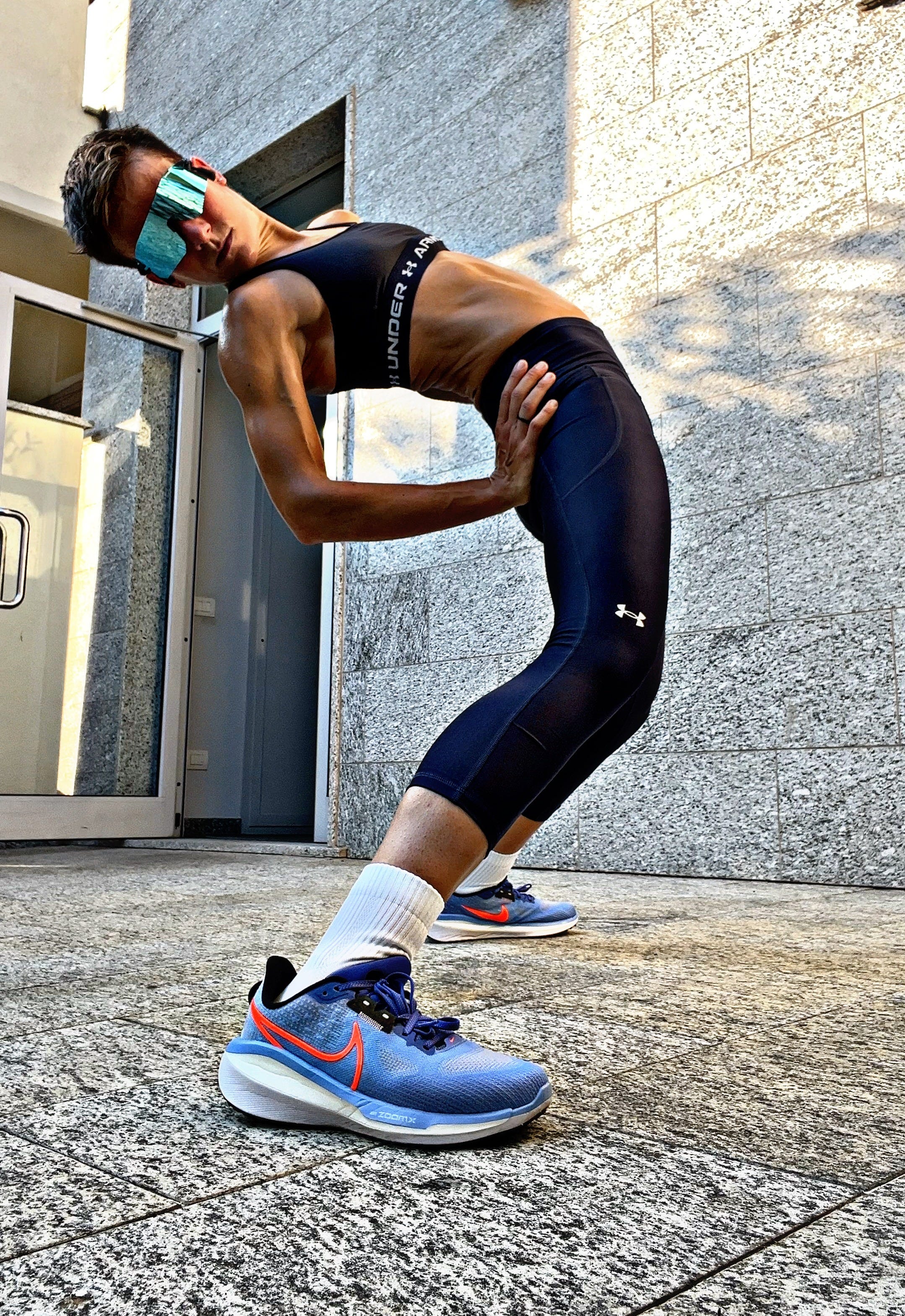
I work out because I like it. And honestly, there isn’t much more to add.
I think in most cases the essence of things has been lost. Many times people do things for reasons that have nothing to do with the thing itself. Often these actions are just meant to silence something else.
I work out because I like working out. It might sound like a snappy answer, but it’s actually very simple and honest.
I don’t feel the need to sign up for a race in order to work out. I used to work out for passion, then I worked out for medals. The medals took the fun away, they made everything full of rules, surrounded by deadlines, expectations to meet, plans to set. Risks to take or not take. Things to do to put yourself in the conditions to reach the goal. And what was that goal? Winning.
Winning. Winning is the goal for many when they pin a number on their back. At least twenty people hope to win, think they can win. Each of them worked to reach that goal.
Only one wins. Three get on the podium. So the one who does more wins.
The one who works out more hours wins, who spends more money on gear, who eats better, who weighs less, who weighs more.
The one who spends more time at altitude wins, who does heat training, who fuels with more carbs per hour. The one who stays standing wins.
Sometimes it feels like a fight between gladiators in an arena. This is true in the professional world—where it still makes some sense—and in the amateur one.
In the professional world, it’s a job, something you get paid for. Even though it’s a job, I don’t agree with the idea of “last man standing.” Every single minute of your life flows into an endurance performance, because every one of them counts. How you eat, how you sleep, how stressed you are, how calm you are, what you did the days before, what you did the season before. But it’s a job; I can still understand the dynamics and accept them.
In the amateur world, I really can’t see the point—not under these conditions. I see too many people, and I’ve often seen myself too, putting races and everything needed to win them before everything else. Some even do it knowing they could never aim at winning, not even close.
To be clear, I’m all for everyone’s freedom. I don’t think my view has to be everyone’s. But when I see this way of acting leading people to live in a self-made parallel world where we do everything to imitate professionals, I stop and think. We’re not professionals, and our time also has to include a job—the one we’re paid for—and a life full of commitments and other activities. Is it worth it? Isn’t there really something else in life you’re neglecting for this?
In the years I raced, the years I did the impossible to fit everything necessary into a workday, I always said they weren’t sacrifices.
They were choices. And it’s true, they were, because I had chosen to put my heart and soul into it. And for a couple of years, two or three, it gave me a lot.
I lived it all fully and climbed in a short time what for most would have taken at least ten years of experience. I lived those ten years in three, but soon I started being unhappy.
Even though I had packed achievements into a few years, I wasn’t really doing things that different from my “peers.”
Sponsorships also came in, obligations, rules I hadn’t chosen. Pressure from others—real or imagined—and from myself.
I’m a free spirit, and when I started, I did everything if and because I wanted to. I decided everything last minute depending on how I felt, and I had fun. No pressure, inside or outside. Then everything changed.
Competition quickly got tighter.
It became a race of who did more hours, more climbing before the race, who went to altitude in the summer or to the heat in the winter.
At some point it clearly became a race of who weighed less, and I never wanted to take part in that race. It disgusted me.
Everything disgusted me.
I was disgusted by the tunnel I was in, by the tunnel I saw others in. I realized it clearly when I was forced to take a break after a crash; that was the first step toward awareness.
At first I couldn’t race because my post-surgery condition didn’t allow it for more than six months. On one hand, it annoyed me, on the other, I felt the excuse was convenient because—really—something else had broken, and it couldn’t be fixed with stitches.
In every situation I try to make the most of it. During that forced break, I took the chance to focus on interests I had put aside.
They were peaceful months despite the obvious difficulties of a slow, painful recovery. My arm was out of action, it hurt day and night. But there were new things I could do, things I had time for.
Since I couldn’t climb mountains on my bike anymore, I climbed them on foot.
I bought a camera, and in my free time I studied how to use it and practiced taking photos (something I still do).
I started enjoying reading again. Quiet.
I rediscovered enthusiasm for work, which had become something I only did with effort to meet certain standards. That same work had gone back to stimulating my brain.
I spent months without riding outside. When I slowly got back to it, I only wanted to have fun. I wanted to have whole days out on the bike, the kind I couldn’t do before so I wouldn’t compromise training.
I wanted to ride for days in a row, exhausting myself without caring about the consequences. Because I like it. Because I can do it, and I want to.
I wanted rides with a tasting goal. Stopping at well-known pastry shops and making my own ranking of the best jam-filled Veneziana.
I wanted to do it all. And I did. Everything I hadn’t been able to do in the two previous years.
That year—even with months stuck at home only able to do a few hours on the trainer—I finished with more than twenty-seven thousand kilometers. I broke every one of my records.
I also broke my record for total elevation gain, because two thousand meters in a ride had become the bare minimum for each weekend day. During the week instead: “under a thousand is recovery.”
I went all in, I caught up on everything I’d missed in the two previous years. All the rules, all the self-imposed restrictions, those imposed by common sense or by others.
By October I was satisfied. So I slowed down. Just enough to face the winter with the right energy.
I had tried running a few times in my life, but it’s not something my body is naturally ready for. Injuries always stopped me. Still, I wanted to try again with the experience I had built in sports, and little by little—incredible—I was running.
Running gives me an even bigger sense of freedom because there’s nothing else but shoes.
If in cycling I can say I’m naturally gifted, for running it’s the opposite, and I don’t use it as an excuse. It’s a fact. You can even prove it scientifically with anthropometric measurements.
Still, I love it.
I don’t care about excelling; I know I never will. Running has put me face-to-face with many physical limits set by my genetics and years of only cycling.
It showed weaknesses I had to work on. Before I could work on them, I had to identify them. Understand what caused what.
Running feeds my thirst for knowledge, my love for the process.
The process of running is definitely not easy. It goes through pain, setbacks, slow comebacks, months of gym work before you see progress.
Running reshapes mental patterns and, as a result, motor patterns.
Let’s remember I’m thirty-five, and some things are well ingrained.
Running reflects way more signals from the body that cycling tends to silence.
Running connects me with every fiber of me.
It was the perfect break before starting cycling training again, and the perfect side activity to keep after.
But things didn’t go as I thought, and I got a second wake-up call to make me realize: “ok Martina, you’ve vented. But there’s still so much more. You never worked out to find limits. You’ve always worked out to improve yourself. In every possible way. Cycling consumed you too much.”
That wake-up call came in two blows.
The first stop was due to hormonal issues that made sitting on the saddle a nightmare. They weren’t clear at first, but between December and January I started facing them with therapies. The first one was wrong, forcing me to cut my bike volume in half—or even more.
I had already started doing more hours on the trainer to avoid road risks, but in that phase switching from outdoor to indoor was often necessary so I could stop a workout at any time and not make it last more than ninety minutes.
By April I was on the right therapy, I’d started doing some longer rides again, but by then working out meant at least two things: cycling and running. Cycling still made up half of my workouts and often came first.
I was almost fine for a week, had done some solid long rides, when the second wake-up call came. And it was right—I had understood, but not enough. I needed more balance.
On April 30th a stabbing pain at the sit bone kept me completely off the bike for forty days. After about twenty, I could add a few light trainer sessions, because I’d learned to sit in a way that almost never hurt and not to move a millimeter. Forty days without riding outside, and since I had two bikes besides the trainer one, I’d even started thinking I should sell them, because—on top of everything—the cause of that pain stayed partly unknown. Tests and exams of every kind and level of radiation never gave clear answers.
During this time, I asked myself many questions and gave myself even more answers. I enjoyed the extra time from cutting down from twenty hours a week on the bike to barely ten, often less.
If you look at the total weekly volume, it’s not that different from the twenty hours I used to do in my race prep years. The difference is in how those hours are made up. The variety of training definitely helps build more complete strength and coordination. And I think that’s undeniable. But what shouldn’t be underestimated are the effects on the mind and stress levels. With the same total volume, changing up the training relaxes your head, breaks monotony, lets your body vary its movements, and if done right, it can even help recovery.
It’s worth pointing out that the more different things you do, the less you can expect to excel in each. The limitation isn’t too much training volume, it’s that you can’t give each discipline enough. That’s what brings the specific adaptations needed to improve performance and make the movement efficient.
The time I used to spend only on cycling is now filled with much more—running, gym, walking, photography, reading, writing.
In these last years I’d even given up on hours of bike maintenance, which I always enjoyed. I didn’t have time, and even though I prefer doing things myself, I handed them off to my trusted mechanic. On one hand, I felt like I was saving time; on the other, I was always going crazy with the bike in the car. One of many contradictions.
I’ve never liked compromises in life. If they help you feel good, I wouldn’t even call them compromises. If they’re to make others feel good, sooner or later they’ll make both feel bad. If they make you a slave to frenzy, they don’t count as feeling good.
So, why do I work out?
Working out is my gateway to so many opportunities. Simply, it lets me take care of my health. It’s fun, for sure. It gives me endless ways to learn and improve.
When I work out, I can start an inner dialogue and reflect. I can relax, I can shut the world off. Or I can dive into the world, into nature. Into peace. Or I can give in to speed, to frenzy, to euphoria.
I work out to express myself.
I work out because I am.
Martina Trevisiol